

I Still Believe in the Movies
It seems like the entertainment industry is collapsing around us, but I still believe stories are the way we drive change.

Last week I was walking through the American Museum of Natural History in New York City with my boyfriend and his two daughters on spring break. As we walked through an exhibit on South America, his eleven-year-old stopped in front of a display case.
Inside was an indigenous feather headdress from South America. She looked at it for a moment and said, with excitement: “That looks like what Juma wears!”

Juma Xipaia is an indigenous chief from the Brazilian Amazon and also happens to be the protagonist of Yanuni, a documentary I worked on this year. It is a beautiful film that was shortlisted for the Academy Awards, with Leonardo DiCaprio as an executive producer and made by award winning documentary filmmaker Richard Ladkani. I brought both girls to a screening last fall, and they had the chance to meet Juma. They were learning about the Amazon in school at the time, and we talked about it for months afterward. The younger one made Juma a card that Juma has framed at her house.
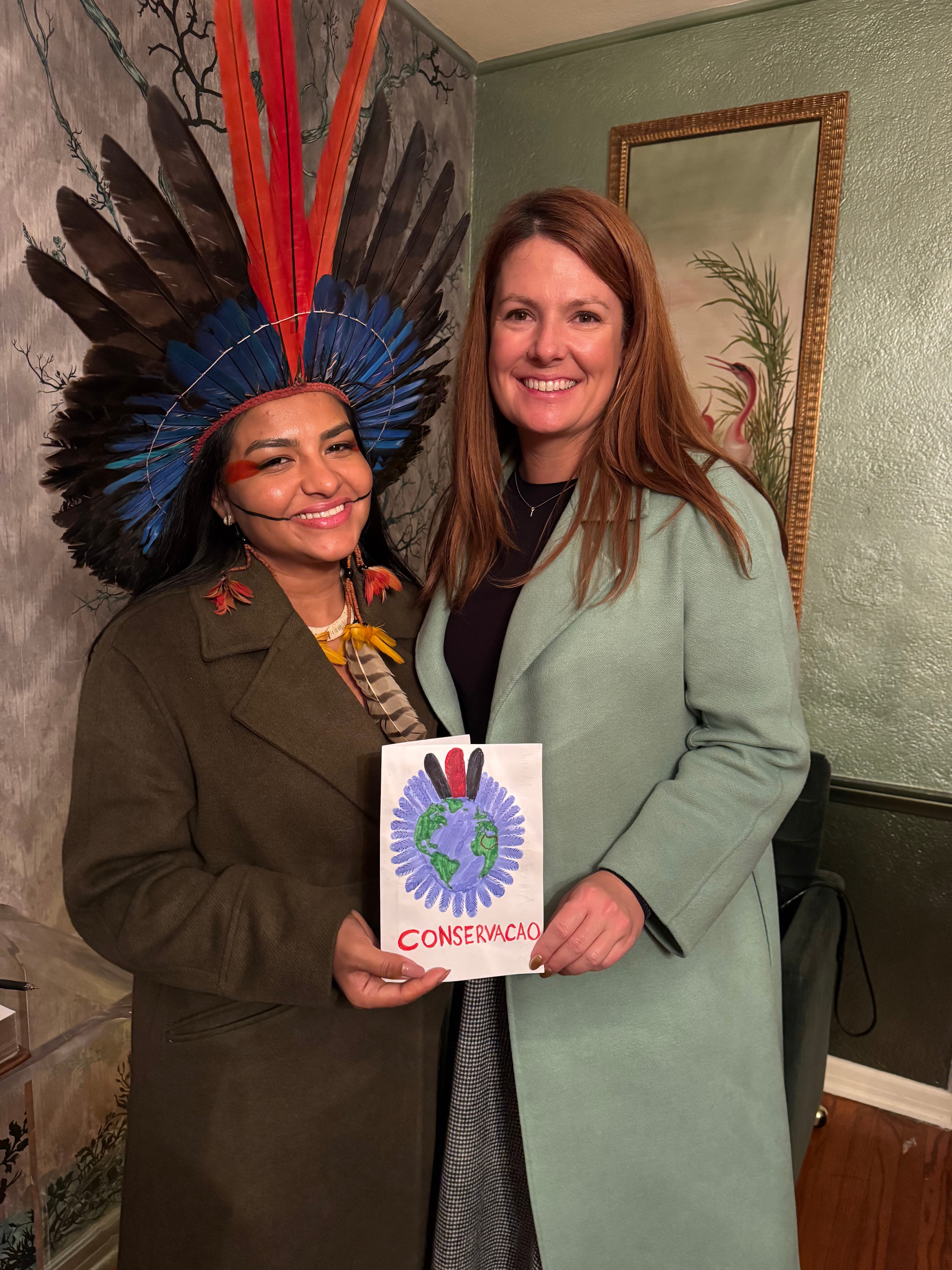
Standing in that museum, in front of a display case that could easily have been just another artifact behind glass, she had context instead. She had a face, a name, a story, a real person she’d met and talked to in mind. The headdress wasn’t a historical object. It was something that belonged to someone she knew.
That is what storytelling does. It’s why I love what I do so much.
I’ve spent fifteen years in entertainment, the last ten exclusively on the social impact side—human rights films, social justice stories, feature films and documentaries about the parts of the world most people aren’t paying attention to until someone makes them impossible to look away from. I went freelance eight years ago and built a real business doing this work, and the belief I’ve carried the entire time is this:
Storytelling is the only way to build empathy at scale.
A news story doesn’t make an eleven-year-old stop in a museum and recognize something as belonging to a person she knows. A film does. That has always been true and it will keep being true, regardless of how the industry changes.
What I’m grieving is that the industry seems to have forgotten it.
Trump ruined everything.
In Q1 of 2025, the cuts came fast and the damage was long-term. As soon as the funding cuts to USAID, the National Endowment for the Arts, and all the other DOGE casualties came through, the funding infrastructure that made impact work viable vanished seemingly overnight. Filmmakers rely on philanthropic funding to support their impact campaigns—grants, individual donations, key partnerships, and institutional support—and it is what made it possible for so many films to get out into the world and make real change. The cuts, coupled with the new pressure on private philanthropy to fill the gaps of institutional funding cuts, means that a significant amount of that is simply gone now.
And separately but certainly related, the industry got scared. The studios and streamers that used to have moral courage—that told stories people were afraid to tell, that understood their own power to open a door or shift a perspective or make someone’s reality impossible to ignore—have gone very quiet. Nobody wants to touch anything that might be perceived as “political”. Nobody wants to be a target. The industry I was drawn to because it was full of artists who understood that art has always been at the center of social change has become, in a lot of rooms, an industry of people waiting to see what’s safe and profitable.
I have friends who have worked consistently their entire careers—people who were turning down jobs a few years ago because they simply had too many offers—who have had no work. Not a slow season. No work. These are experienced, talented, sought-after people, and the thing they built their entire professional lives around has become uncertain in a way none of us have seen before.
The career I thought I’d have forever.
There’s a particular kind of grief that comes from loving something that can’t love you back the way it used to. It’s not heartbreak exactly, but it’s more like watching someone you deeply admire go through something that’s changing them, and not knowing yet who they’ll be on the other side, and having to keep showing up in the meantime.
When people ask what I would do if this work stopped being viable, I genuinely don’t have an answer. I’ve thought about it, but the reality is, there isn’t one. The stories, the work of getting people to see them, the belief that a film can do something a news story or policy paper cannot. That’s not just a “job” to me. It’s a conviction I’ve had since before I knew it was a career. And it makes this moment harder, not easier, because it would be so much cleaner if I’d simply outgrown the work or wanted something different after fifteen years. Instead I want exactly what I’ve always wanted, in an industry that is contracting around me in real time.
Yanuni didn’t get distribution. A film shortlisted for the Academy Awards, with one of the most recognized climate advocates in the world attached as an executive producer and an award-winning filmmaker behind the camera. And it didn’t get distribution. I’m still not totally over it. The work was extraordinary. The story mattered. And the industry, in this particular moment, didn’t have room for it.
Why didn’t they have room? Because it’s a documentary that is not pop culture, true crime, sports, or celebrity-driven. It’s about climate activism in an era where everyone wants to play safe.
These are the exact kinds of films that are the most important for people to see, and now audiences don’t get the thing that would have opened something in them. The eleven-year-olds won’t have the context when they stop in front of the display case.
The truth is, I wanted to do this forever. I knew the shape of the work would evolve over time—that’s the nature of any industry, and honestly I’ve always loved the problem-solving that comes with change. But I didn’t expect it to fall off a cliff. I didn’t expect the industry to be taken over by corporate conglomerates whose primary relationship to art is as a line item, who are more afraid of catching the ire of this administration than using the cultural power they actually have to stand up for something.
I’m grieving what entertainment used to be. The moral courage of it. The belief, shared widely enough to act on, that stories could change things and that was reason enough to tell them.
Eight years of working for yourself teaches you a few things, and one of them is that you can adapt. That pivoting isn’t failure—it’s just what you do when the ground shifts under you, and the ground has shifted under me more than once. I know how to find the new footing. I’m doing it right now, actually, figuring out what the next version of this work looks like and building toward it with the same stubbornness I’ve brought to everything else.
I’ll be okay. I know I’ll be okay.
I’m just also sad. And I think that’s allowed.
I’m Kathleen, a creative strategist and small business owner with 15 years in entertainment. I run awards and impact campaigns for clients like Netflix, A24, Apple TV+, Amazon, and HBO, build impact partnerships, and write about work, romance novels, and living a bicoastal life.